 EMDR Flow
How to practise EMDR Phase 3: image, NC, PC, VOC and SUD
EMDR Flow offers fictional virtual-patient cases for practising Phase 3 target assessment, including image, cognitions, VOC, emotion, SUD and body location. On iPhone, iPad or Mac, Coach feedback helps you review your decisions and prepare questions for human supervision.

EMDR Phase 3 organizes one defined target before reprocessing. Assessment commonly records the image that represents the worst part, a self-referential negative cognition, the desired positive cognition, validity of cognition (VOC), current emotion, subjective units of disturbance (SUD) and body location. The skill lies in how these elements relate, not in filling seven boxes from memory.
Practising this phase exposes vague questions and skipped steps. It belongs inside recognized EMDR training and should be reviewed with human supervision. A virtual case offers repetition and feedback against a programmed scenario; it cannot validate wording for a real client or certify clinical competence.
The seven elements of target assessment
First delimit the memory or situation and ask for an image that represents the worst part. Explore the negative belief about self that fits that image, then what the person would prefer to believe now. A positive cognition need not sound optimistic; it should be desirable, self-referential and relevant to the target.
VOC indicates how true the positive cognition feels in the present, commonly on a 1-to-7 scale. Assessment then identifies emotion, SUD from 0 to 10 and where the activation is felt in the body. These are subjective session measures, not diagnostic tests or performance scores.
- Image or moment representing the most disturbing part.
- Negative cognition (NC) about self linked to that image.
- Desired positive cognition (PC) addressing the same target.
- VOC from 1 to 7 for the felt truth of the PC.
- Emotion or emotions present now.
- SUD from 0 to 10 for current subjective disturbance.
- Body location of the current sensation.
VOC and SUD measure different things
VOC asks how true the positive cognition feels while the person connects with the target. SUD asks how disturbing the target feels now. Low VOC does not automatically mean high SUD, and their scales should not be interchanged. Repeating the precise anchor for each question reduces ambiguous answers.
Neither number should be chased as an isolated objective. They are process markers interpreted alongside narrative, body response and clinical judgment. If a value changes unexpectedly, explore context rather than correcting the client to fit a predicted trajectory.
- Return to the selected image rather than the whole history.
- Phrase the NC as a present, self-referential belief.
- Check that the PC answers the same domain as the NC.
- Ask VOC on its 1-to-7 scale, then emotion and SUD from 0 to 10.
- Complete assessment by locating the body sensation.
Practise a complete assessment with a fictional case
EMDR Flow lets you rehearse questions, inspect the case record and retry decisions. AI training feedback complements human training and supervision; it does not replace them.
Try the EMDR simulator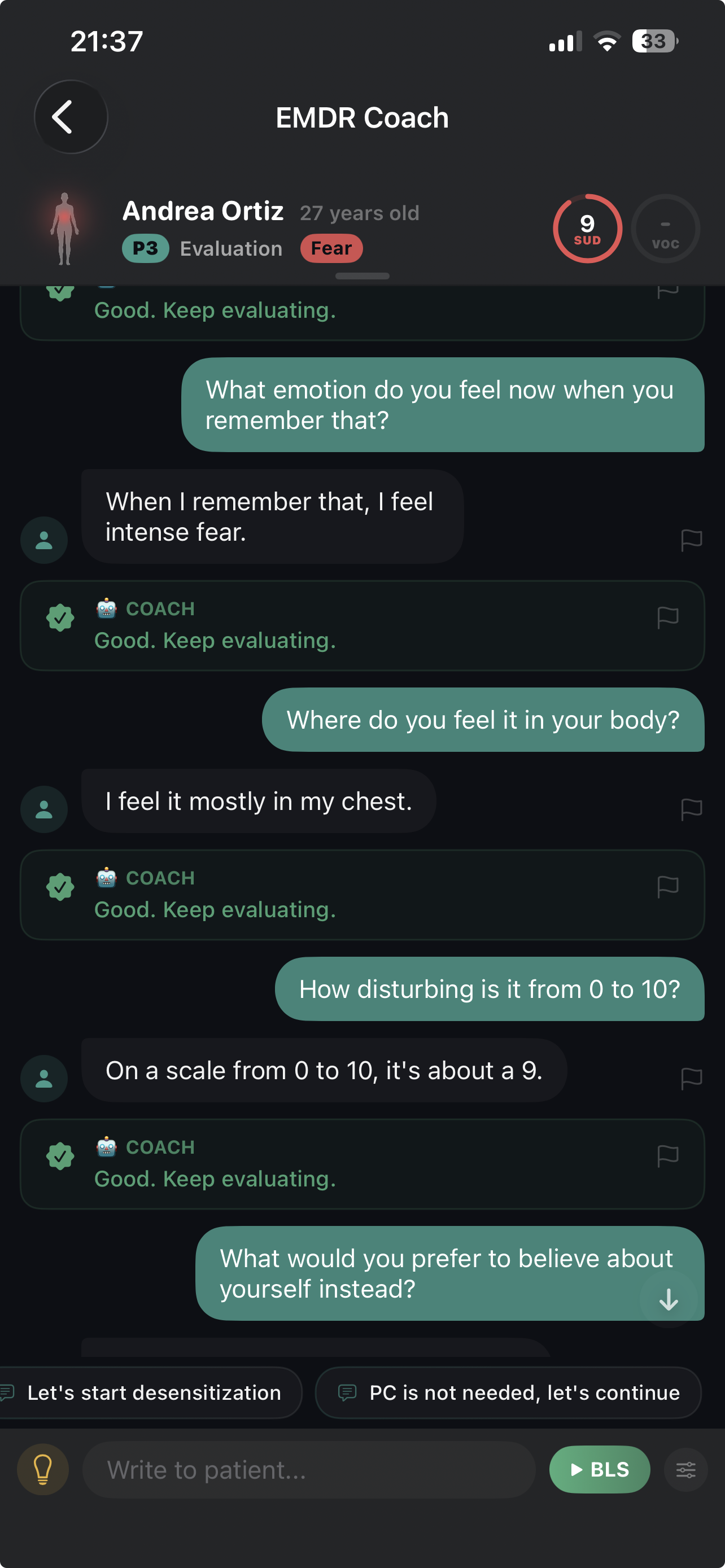
Useful errors to rehearse in simulation
The most instructive errors include starting BLS before assessment is complete, accepting an NC about another person, suggesting a PC unrelated to the target and confusing VOC with emotional intensity. A useful exercise pauses the sequence and asks which information is missing and why it matters.
Replay the same micro-case while changing one formulation. Compare how the case record changes and write the question you would take to supervision. This turns simulation into deliberate practice instead of accumulating completed sessions without reviewing the reasoning.
Using the Coach without confusing feedback and supervision
The EMDR Flow Coach can respond to questions in a fictional case, display SUD and VOC and flag choices anticipated by the scenario. Use it to rehearse sequence and make uncertainty visible. Do not assume an approved sentence is the only valid intervention or that a score represents skill with clients.
Compare the exercise with your course materials and a qualified supervisor. When an AI response conflicts with accredited training or human clinical guidance, the professional framework takes priority. Do not enter identifying information from real clients into a training simulation.
Frequently asked questions
What is the difference between VOC and SUD in EMDR?
VOC commonly rates from 1 to 7 how true the positive cognition feels; SUD rates current subjective disturbance from 0 to 10. They measure different constructs and need their own anchors.
Can a simulator teach EMDR Phase 3?
It can help rehearse sequence, compare wording and prepare questions for supervision. It does not replace accredited training, supervised practice or assessment of a real person.
Training reference: EMDRIA consultee skills checklist.