 EMDR Flow
EMDR practice cases: train a decision, then debrief it
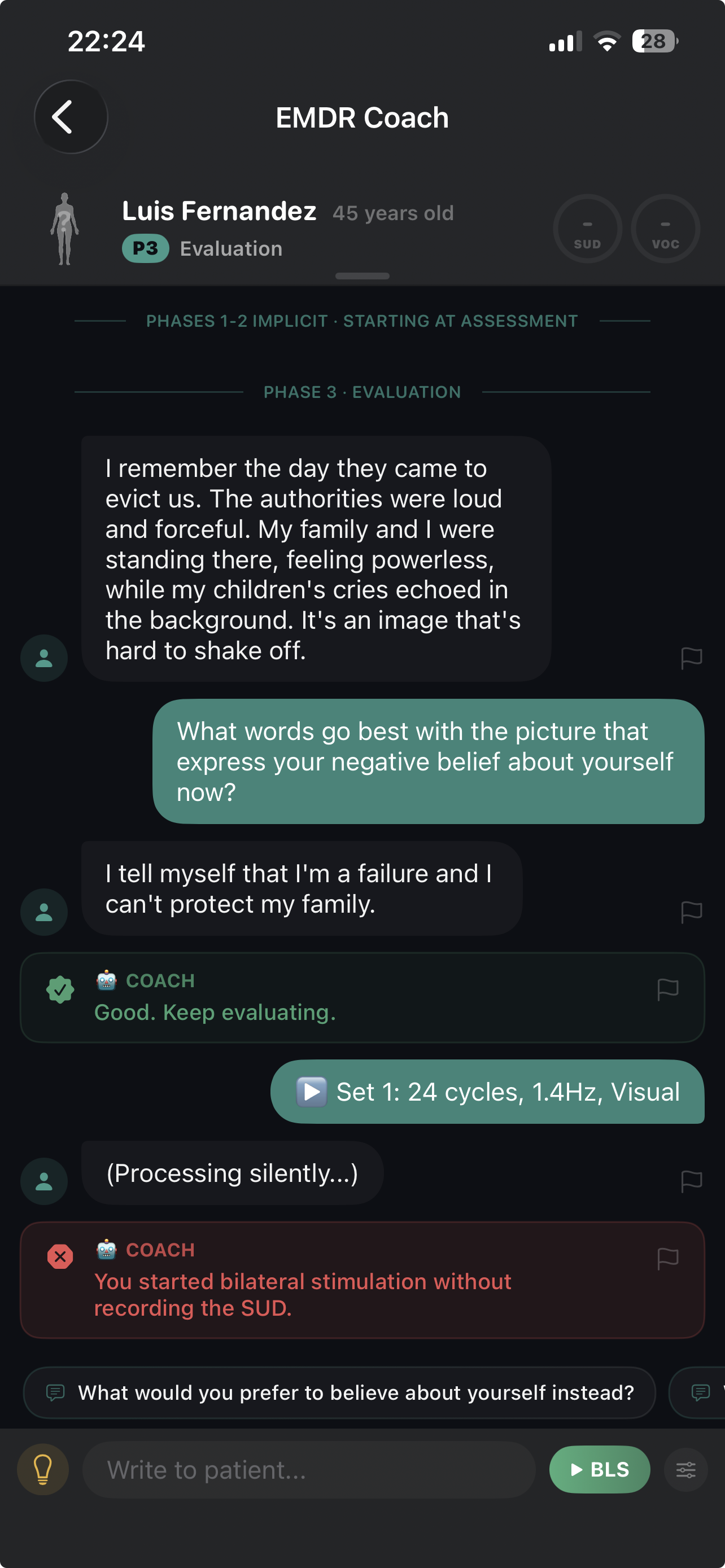
For interactive EMDR practice cases, EMDR Flow lets therapists work with fictional virtual patients and receive Coach feedback on their decisions. The app runs on iPhone, iPad and Mac; the current exercises focus on target assessment and processing decisions, making it useful for repeating a difficult decision between teaching and supervision sessions.

An EMDR practice case is most useful when it asks you to make one defined decision and explain the evidence for it. Reading a solved vignette can refresh knowledge. Choosing an intervention, seeing a fictional response and reviewing your reasoning exercises a different skill.
The case still has limits. It does not reproduce nonverbal communication, therapeutic alliance, risk, culture or responsibility toward a real person. Its role is to make your reasoning easier to inspect before you take a question into qualified supervision.
Choose the format for the skill
Written vignette
Good for formulation and target planning. It does not rehearse timing or dialogue.
Peer role-play
Good for language and pacing. The colleague playing the client may know too much.
Recorded session
Good for observation. You cannot test what would happen after a different choice.
Branching simulation
Good for repetition and comparison. Its response remains a model, not a real client.
What a strong practice case contains
- A named learning target: for example Phase 3 assessment, a decision during processing or closure of incomplete work.
- Enough information to decide: relevant fictional history and measures, without giving away the intended answer.
- Plausible alternatives: more than one choice should deserve consideration.
- A response to the action: the case changes after the intervention instead of showing a detached explanation.
- A bounded debrief: the feedback says which training rule it used and avoids presenting one score as clinical competence.
Work one decision instead of finishing for points
Choose a narrow question before starting. During the scenario, pause at the first moment that produces doubt and write down the observable facts. State your action and the reason for it before opening feedback. Then replay only that point with one changed choice.
This method separates deliberate practice from completion. Finishing many cases quickly can rehearse the same habit; revisiting one uncertain transition can reveal it.
A five-line case debrief
- Phase and decision: where did I pause?
- Observed facts: what did the fictional case actually provide?
- My inference: what meaning did I add?
- Alternative: what other action was plausible?
- Supervision question: what needs qualified human discussion?
Practise with a virtual patient
EMDR Flow presents fictional cases, lets you choose interventions and gives immediate feedback based on its training logic. Current exercises focus on target assessment and processing decisions. The feedback is educational and is not accredited clinical supervision.
Try an EMDR Flow caseKeep real client information out of the exercise
Use the fictional cases supplied by the training tool. If an educational setting uses case material drawn from practice, follow its consent, de-identification, legal and institutional requirements. A convenient text field is not permission to copy clinical notes.
Frequently asked questions
What makes an EMDR practice case useful?
A useful case creates a specific decision, provides enough fictional information to justify it and supports a structured debrief. It should state which part of the protocol it exercises and where human supervision is still required.
Can I enter information from a real client?
Use fictional or properly authorized training material. Do not copy identifiable client notes into a simulator unless you have an appropriate legal basis, consent and institutional policy.
How many simulated cases prove clinical competence?
No number of completed simulations proves clinical competence. Accreditation, observed practice, qualified supervision and the requirements of your professional body remain essential.
Next: try the EMDR training simulator with AI virtual patients, practise the seven Phase 3 elements or review remote EMDR setup and evidence.